
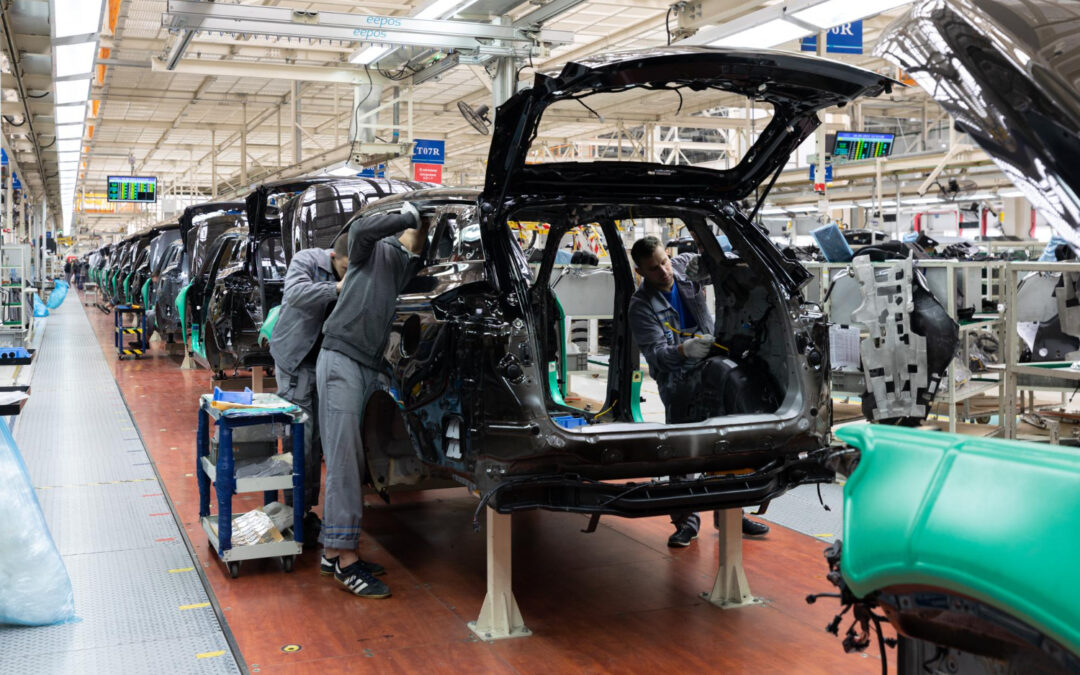
The term “energy saving” implies actions or initiatives that help to reduce energy use, often those that offer staff and customers a faster payback and improved cash flow (actual or the projection), which subsequently attract resources for their implementation. However the focus of energy saving should also include actions aimed at a reduction of emissions of greenhouse gases (CO2 and other gases) per manufactured vehicle or the production processes intensity (energy use per manufactured vehicle). Energy saving initiatives are those actions that have the potential to positively affect energy cost, manufacturing quality, production lead time and the competitiveness of the manufacturer. Energy saving does not extend to changes to supply chains that simply transfer emissions associated with a process to another location, e.g. the use of lower emission transport suppliers or the consolidation of shipmen energy consumption in the supply chain.
Energy consumption in the British automobile manufacturing industry is mapped in terms of energy supply mix and sources, type of energy consumed in the energy sectors, an assessment of whether energy intensity in the British automobile manufacturing industry is above or below the intensity in other continental automobile producing nations such as Japan, Korea, Germany, France, Spain, Italy and the USA or in fact the World average, and an identification of the process categories and processes with the largest energy consumption. Additionally the regulatory landscape that governs the consumption of energy in the British automobile manufacturing industry is examined, with a particular focus on the EU regulatory environment governing the emission of greenhouse gases, other market drivers such as the government assisted responsive transport project and the green automobile financing policy of the British government and whether the market place is starting to reward automobile manufacturers with lower emissions of greenhouse gases.
2. Energy Landscape in British Automobile Manufacturing
Establishing potential for energy savings begins with characterizing the energy landscape of the British automobile manufacturing industry. The energy consumption and greenhouse gas emissions associated with the production of passenger cars and vans are examined, with particular attention to the electricity and gas used in each major sector of manufacture. Current energy usage is compared with that of the French and German automobile-producing industries to assess operational efficiency. The energy mix and rate of adoption of low-carbon technologies are also explored, with consideration for the implementation and impact of future regulation alongside shifting public perception of vehicle emissions.
The primary goal driving these analyses is a reduction in energy intensity—defined as the total quantity of energy consumed per vehicle produced. Success depends upon: the need to improve the competitive position of UK-based automobile production facilities relative to manufacturers in France and Germany; and the desire of the UK government to reassure the public that the automobile industry is taking its environmental responsibilities seriously. Exploiting the energy-saving potential of new manufacturing technology must therefore be undertaken in conjunction with other initiatives that address cost, quality, and finished-product demand.
3. Process Improvements for Energy Efficiency
Energy efficiency lowers unit energy cost while reducing production and transport emissions, cutting carbon taxes, and improving responsiveness by decreasing energy capex and making operations more predictable—all valuable attributes in today’s carbon-constrained economy. A range of methods can deliver process energy efficiencies in automobile manufacturing.
Optimising Assembly Line Performance The assembly line is the production rate bottleneck, so optimising its smoothness, load balancing, and energy usage typically leave the most room for energy improvements. Issues to investigate include identifying where delayed work accumulates, aligning individual workstations to the takt time, reviewing areas where heat is generated, and checking that tooling requiring excessive bursts of energy, e.g. for pressing or welding, is being reused at every opportunity. To further improve energy efficiency, it is worth setting up a line-side energy monitor that helps flag especially high-consuming cycles, distinguishing these from general wastefulness. Making known equipment down-time common to the line—and thus systematic—also helps improve accuracy when calculating energy per unit. Finally, cycle times at each workstation should be examined to determine whether growth can be avoided or eradicated.
Applying Lean Manufacturing Principles and Reducing Waste Lean principles provide significant advantages to energy performance, so identifying opportunities for Kaizen bursts affecting overall asset utilisation are useful. Value-stream mapping pinpoints typical flows of parts and assemblies, making it easier to highlight areas of waste and target reductions. Particularly high energy intensity parts provide valuable clues on improving batch sizing. Recovering scrap heat is another area of promise, especially at the paint shop. Implementing a simple system to track energy consumed per vehicle completes the information cycle.
3.1. Assembly Line Optimisation
Reducing assembly line energy intensity while improving speed and quality boosts competitiveness. Key options include changing cycle times to balance line bottlenecks, prioritising energy-efficient heat-generating tools, standardising downtime, and installing line-side energy monitoring to highlight energy-hungry tools needing efficiency improvement. Temperature control, external heat sources, and cooling power consumption should be assessed for opportunities to recycle waste heat. Production tooling definition investigations should include energy intensity and efficiency as key selection criteria. In sequences with varying cycle times, standardising the slowest cycle time will optimally reduce line energy consumption.
Incorporating lean manufacturing principles and techniques on the assembly side will also yield energy and emissions savings. Value-stream mapping clarifies where excessive time is expended on non-value-adding elements and highlights key drivers of manufacturing lead time that can be reduced and are candidates for Kaizen activity bursts. Reducing subassembly sizes minimises handling energy use. Energy use per vehicle for each sub-process should be tracked over time on a visual management board, identifying Kaizen bursts targeting overall asset utilisation as a priority.
For general factory services, LED lighting upgrades remain an obvious first step. Intelligent lighting operation and control, and planting HVAC systems in zones governed by production activity and occupancy schedules represent straightforward next steps. Duct insulation, waste heat recovery, and moving power-hungry activities to off-peak energy tariff periods complete a sensible list of foundational actions for factory infrastructure.
3.2. Lean Manufacturing and Waste Reduction
Value-stream mapping highlights key areas of waste for focused effort. By reducing excessive inventory and operator transfer times, batch sizes become smaller and energy use per unit decreases. Quality control placed earlier in the manufacturing process mitigates the need for energy-intensive scrap processing. With reduced waste, the cycle time should approach the takt time, enhancing overall asset utilization. Achieving processing capacity in line with demand eliminates or diminishes the penalty of carrying peak loads and thereby improves asset utilization. Tracking energy used per unit produced in each segment of the supply chain facilitates targeting of Kaizen bursts that will drive up overall asset utilization. Energy use can be reduced further by capturing recovered energy before it is lost: recuperating heat from painting ovens or heat exchangers using waste heat from other operations would be an obvious step to consider, although there are practical difficulties in capturing latent heat from humid processes.
Kaizen Han is a Japanese term indicating small, continuous improvement in all areas of work. Large-scale processes may provide occasional focal points for energy improvement; however, they rarely change by more than a few percentage points in any one year. By focusing on smaller-scale changes on a continuing basis, the total improvement can become significantly greater than for the seldom-visited large change.
3.3. Lighting, HVAC, and Plant Infrastructure
Upgrading lighting to LED technology and incorporating intelligent controls facilitate substantial energy savings. Outside working hours, a considerable portion of a plant’s electrical load is typically consumed by lighting. Sensors can therefore automatically turn off lights in unoccupied areas. Should certain areas remain lit while unoccupied, automated control of grown-light can reduce energy consumption. Daylight sensors can dim LED lamps in areas where daylight enters. Additional examples of intelligent lighting controls include dimming based on season and occupancy-based command of light scenes.
Heating, ventilation, and air-conditioning (HVAC) energy consumption can also be reduced through intelligent control. Different parts of the plant can have different heating, cooling, and ventilation requirement profiles. For example, offices can often have a different heating/cooling profile than production areas, and production lighting can produce waste heat. Zoning HVAC according to occupancy and production schedules is therefore an effective measure. Sloping insulation of an HVAC duct is an additional measure that reduces heat-losses without significant expense or effort.
Waste-heat recovery can further reduce energy use and costs. Activities with high thermal energy demand at the same time may allow scheduling during the period of waste-heat availability. Scheduling high-load activities during hours when the price of electricity is low (for example, at night) may also lower energy costs.
4. Energy Systems and Technology
Continued gains can be achieved by exploring the energy demand imposed by the tools and systems used in production. An electrified assembly line places specific emphasis on the energy needs of robotic tools, while demand-side technologies offer considerable potential to capture and re-use energy.
Electrified Tools and Robotics In areas where tools and robots are powered by electricity, attention should be paid to the energy consumption profiles throughout the process. Wherever movement is required, consideration should also be given to making this as energyefficient as possible, whether through motion profiling of the tools or during robotic operation by combining objectives such as speed, acceleration, and trajectories through the use of intelligent programming that takes energy into account. For mobile tools, check that standard charging functions are in place, along with systems that capture energy from the battery during braking or inactive periods.
Energy Recovery and Cogeneration Across the plant, potential sources of waste heat should be mapped out and the feasibility of recovering and using it to provide steam or hot water considered. For very large plants, ORC solutions could even be economic. Consideration should be given to an on-site generation solution that includes some storage in order to smooth demand and reduce peak tariffs.
Electrification of Vehicle Subsystems and Testing Support development through the use of energy-efficient test rigs that recover power taken from the mains for the test session. Evaluate the climate chambers and any auxiliary power drain from equipment. Collate testing data with a view to capturing additional power that is currently treated as idle for these tests. Where test data is extensive, work with a data analytics partner to further refine the test sequences and reduce idle energy.
4.1. Electrified Tools and Robotics
Electrified Tools and Robotics
Assess energy profiles of tools and robots, enabling operation-by-motion efficiency for faster cycle times. Embrace energy-aware programming for parallel operation with energy-consuming activities. Standardize charging on-shift and reuse battery energy during braking or idle state.
Energy-aware programming can parallel high-power cycle tests in e-motor systems or component testing operations. Automated guided vehicles should regenerate braking energy and trolleys be routed for minimum energy-consumption impact.
4.2. Energy Recovery and cogeneration
Energy systems that convert one form of energy to another (e.g. heat to electricity) cannot break even from a thermodynamics point of view. However, parts of energy not recoverable into the same form or obviously utilizable can be recovered and employed elsewhere without loss or increase in the original energy values. In many manufacturers, recovery of energy is practiced through process cooling and heating systems at little or no heat energy cost. Other common heat recovery methods include for boiler flue-gas exhaust vapour and engine test-bed cooling systems. Examples are given in the following sub-sections.
Explore main suppliers of heat energy and consider recovery payback time. Where investment in energy Hot Water or Steam stores shows good return, include generation in future plans. Generation should also be considered when the mixture of self-generation, storage, and economy tariff will reduce energy costs sufficiently or significantly; paying to provide storage electrolysis for future hydrogen usage will depend on market fluctuations.
4.3. Electrification of Vehicle Subsystems and Testing
Integrating energy-efficient testing rigs for subsystem evaluation spares electric vehicle components the steep energy costs of testing on a complete vehicle platform. However, these component tests still draw auxiliary power during operation. Optimizing climate chambers can help minimize their energy requirements during testing cycles. Software development for these rigs often proceeds independently from the physical tests. By integrating data analytics, and especially machine-learning algorithms, into the process, it is possible to study real-world driving patterns and craft optimization sequences that reduce the climate chamber energy footprint and the energy consumed per test.
Power electronics, motors, and batteries are the electric vehicle subsystems consuming the most electrical power during real-world operation. However, preliminary tests using prototype parts depend on complete vehicle testing for validation. During these tests, the components do not contribute energy. Instrumenting these tests to recover auxiliary energy during operation can partially compensate for the energy the components would have consumed. Workload-aware scheduling of these auxiliary-engineering support processes can further reduce the associated energy-intensity burden.
Integrating data and graphical-analytics tools with electric-vehicle test sequencing and scheduling will also help manage test workloads. For example, once the vehicle is at the final test-inflection-build milestone, analytics can help sequence the tests such that the combined climate-chamber electricity consumption is minimized. Additionally, during these combined validation tests, analytic tools can manage the sequencing to absorb as much testing auxiliary energy as possible, further enhancing the electric-vehicle test energy profile.
5. Supply Chain and Logistics
Actions to reduce energy costs often focus on internal processes and energy systems, but supply chain and logistics provide many opportunities for savings as well. Improving energy efficiency in material handling and transport can also support other priorities, such as increasing product availability. Moreover, suppliers’ energy performance indirectly affects manufacturers’ energy use.
Optimization of intra-site logistics can reduce energy use and emissions. For example, the deployment of automatic guided vehicles equipped with regenerative braking capabilities can reduce energy consumption when compared with conventional vehicles. Energy consumption with respect to ton-kilometer or unit product also helps establish the targets for improvement. Route optimization and space reduction can also play an essential role.
Improving energy efficiency during transportation can yield similar benefits. Combining shipments of low-volume items from different suppliers not only reduces energy and cost, but also can enable the petitioner to impose minimum shipment quantities. Serious consideration should be given to supplier change for materials transportation. Monitoring the fuel intensity of the suppliers’ logistics makes it possible to follow up on their needs for efficiency improvement. Attention also should be paid to incorporating transport suppliers’ energy use in the total cost of ownership evaluation of components.
5.1. Material Handling and Transportation
Intra-site material handling plays a critical role in overall energy intensity and has typically been neglected. Value-stream mapping can assist in identifying waste and council for reduction or automation of redundant processes. For automated guided vehicles, especially in environments requiring significant heating, regenerative braking would improve energy efficiency. For sites with multiple manufacturing buildings, communication of mats and consolidation of shipments can limit transport energy. Where non-road vehicle fuel intensities are known, adrenaline fuel intensity formula can indicate fuel mileage.
Energy intensity monitoring can motivate initiatives to switch to low-emission transport suppliers. Suppliers that offer energy performance data as part of the partnership should also be monitored to ensure that the expected benefits are seen. The supply of materials and components should be aligned with Lean principles in order to both minimise costs and meet customer demands.
External transportation represents a large share of the energy associated with finished vehicles. In addition to optimising the mix of external transport suppliers and type of delivery vehicle used, monitoring transport intensity across the network of suppliers can indicate issues and act as an early warning system for sudden peaks, since they must still be fulfilled.
5.2. Supplier Energy Efficiency
Suppliers are in the driving seat when it comes to the overall vehicle carbon footprint; however, they often do not disclose energy performance data and do not address energy efficiency enhancement with the same intensity as core automotive companies. To overcome this issue, purchasing policies should also account for supplier energy usage and efficiency; companies should request energy performance data, share energy reduction best practices, consider running collaborative supplier energy improvement programs, and offer energy efficiency improvement support, both technical and financial. High-volume suppliers producing low-cost products using unsustainable energy profiles should be singled out for more detailed requests; targeting these relationships can significantly enhance both direct and supply chain carbon footprints.
In conclusion, prioritising energy-efficiency improvements in the supply chain is highly beneficial due to the suppliers’ high energy consumption and intensity. For automotive manufacturing, where about two-thirds of CO2 emissions originate from the supply chain, energy efficiency in supplier operations is a must; responsible purchasing actions ensure that suppliers enhance their energy efficiency. By requesting from Tier 1 manufacturers the supply chain’s packaging and supply energy intensity, automotive companies further extend their approach. These indirect energy efficiency requirements and supportive actions ultimately help the entire supplier base.
6. Policy, Incentives, and Compliance
Characterising a sound and sustainable energy strategy goes beyond a pure technological approach. Though new technologies are generally at the forefront of internal discussions and external communications, they tend to require substantial capital investments and usually take longer to implement than process improvements. Suppliers can be encouraged to improve their energy use, and those with the least energy-efficient processes are often the most energy-intensive transport suppliers.
Since energy-saving opportunities can stem from diverse sources, it is vital to develop clear, coherent policies that steer those factors contributing most to energy use. Six areas warrant special attention: (a) recognition of regulatory standards and impending deadlines; (b) identification of available financial incentives and grants; (c) establishment of a policy and framework for periodic energy-minimisation reviews; (d) requirement of energy-performance data from suppliers; (e) a sector-wide increase in energy awareness; and (f) inclusion of energy performance in procurement decisions. Determining such policies and addressing these points will help organisations identify priority areas and where external support can add high value.
6.1. Regulatory Standards
To ensure compliance with present and impending laws, manufacturers should maintain an up-to-date overview of relevant UK and EU regulatory standards and deadlines, a growing list of which will demand enhanced energy performance and certification. While large manufacturers typically have standard-compliant management systems in place, others may consider designing and implementing an estate-specific energy management system that follows the ISO 50001 approach to facilitate certification.
The UK Government’s commitment to net zero by 2050 and the European Union’s Green Deal, which sets the goal of reducing GHG emissions by at least 55% compared to 1990 levels by 2030, set stringent expectations for businesses within the UK and the EU. Energy performance across all sectors is central to both strategies, and monitoring, steering, and policies shaping the automotive supply chain are facilitating continuous energy improvement actions.
The UK and EU ETS serve as market-based mechanisms to provide strong incentives to achieve decarbonisation at minimum cost, while energy taxes aimed specifically at reducing energy consumption are also imposed.
6.2. Financial Incentives and Grants
Identifying available subsidies, tax reliefs, and grants helps prioritise projects with favourable payback. The UK government’s Energy Technology List includes products eligible for enhanced capital allowance, while the Energy Savings Opportunity Scheme and Climate Change Agreements provide further opportunity for energy tracking and capital investment tax relief.
An increasing number of energy efficiency measures are supported by grants (often covering at least 30%) such as the Low Carbon Fleet Programme and the LCV R&D fund. The EU’s Horizon 2020 fund may also be available for multinational projects involving resource efficiency or decentralised energy generation. The UK’s patent box also affords substantial relief on profits from patents registered in the UK.
Central support availability shifts without notice as lead candidates are replaced with challenger parties. However, organisations successfully exploiting the range of available financial incentives presently on offer often unlock new business models and practices pioneering sustainability within their respective product categories.
6.3. Reporting and Continuous Improvement
A regular review of energy consumption can yield immediate identification and correction of problems, and any insights gleaned should feed into future projects. Reports should include conformance to the above plans, with updates on energy-saving projects, their costs and savings, progress toward meeting energy intensity targets, and the degree to which suppliers are acting on energy efficiency prompts.
The energy reviews should also be made publicly available. This automatic signalling of attention to energy efficiency can be a useful marketing tool, since recent history suggests that it, like safety, is one of those things that customers expect a large manufacturer to be good at—and rewarded accordingly. Companies that do it very well indeed can exceed expectations and reap a competitive advantage. Incorporating information from these reviews into the annual accounts is an important step in this direction. Finally, establishing a reliable and widely used database of energy consumption will help capture any lessons learned. Such information is particularly valuable for the next round of Kaizen bursts, but it should not be limited to that context. Integrating these energy reviews with the energy elements of the business-wide capital planning process ensures that their lessons will continue to inform investment priorities in the future.
7. Case Studies from British Manufacturers
Small and medium enterprises have found opportunities for energy savings through relatively simple, low-cost retrofits that typically deliver a short return on investment. One recent example is changing the light fittings in a paint shop to LED: better quality lighting has improved quality control while the new fittings are expected to pay back within 18 months. Another company is experimenting with data-logger-enabled light-switch timers in two areas with limited resources; if the trial proves successful, then a roll-out will follow. Collaboration with suppliers has opened up new savings opportunities. One manufacturer uses wideband noise measurement equipment on a per-shift basis for monitoring supplier testing levels. Data post-processing and reporting were time-consuming, so a streamlined process with data visualisation software was implemented.
Large-scale producers operate at a level of complexity requiring energy strategies that take account of multiple interdependencies. One company has implemented a plant-wide energy management programme that includes regular energy and CO2 emission audits with data collection performed at the line level. A digital twin of the facility was created for harmonizing production planning with energy cost and carbon intensity constraints, leading to improved utilization of hot water storage, compressed air, and other shared resources. Energy requirements for individual equipment are integrated within the wider maintenance management framework, ensuring that energy is viewed as an integral-to-operation resource rather than a standalone cost area.
7.1. Small and Medium Enterprises
Examples from small and medium-sized enterprises (SMEs) in the sector illustrate how even relatively simple measures, such as retrofitting for energy efficiency, can deliver quick payback. The gains achieved in individual factories can often be multiplied by applying the same principles on a broader scale. One company has collaborated with a major customer to develop new models allowing energy consumption by suppliers to be included as part of the total cost of a contract, enabling the relationship and the energy cost base to be effectively managed.
Ford has examined weaknesses in its energy data across the wider company and has instigated a series of pilot projects to address them. Site energy programs have been linked to a digital twin model that identifies energy intensity hotspots throughout a full-charge cycle for the whole plant. Reporting on energy intensity performance is becoming integrated with the maintenance function to allow considerations of energy during repairs and upgrades, making energy savings part of the maintenance culture rather than the preserve of a single department.
7.2. Large Scale Producers
Plant-wide energy reduction programs are under way at leading UK-based manufacturers, supporting commitments to carbon neutrality by 2030. These energy strategies encompass the entire production plant, integrating energy with all major engineering considerations, including supply-chain operations, maintenance, and the exponential technologies.
The manufacturing program of energy reduction aims at achieving the following improvements: Motors, HVAC components and energy management systems are monitored to ensure they interact effectively; Each significant electrical consumer is provided with two-way power monitoring to improve overall usage; Digital-twin models are used to fuse sensor data, predict outcomes and provide supporting decision information; Artificial intelligence is used to increase the reliability of predictive maintenance; and the performance impact of these projects on plant energy use is captured and fed back to the strategy team for continuous learning. Digital-twin models are used to fuse sensor data from the plant, operate it more efficiently, and test potential changes in management. By monitoring all major variable costs of individual plants, a pockets-of-excellence management centre assesses overall performance and highlights areas for further improvement.
8. Challenges and Risks
Data availability limits the resolution of some insights. For example, the investment case for on-site renewable generation is challenging without sufficient solar generation data, particularly in Northern and Western Europe where sunlight is less plentiful. Similarly, site generation is not viable for manufacturers with small indoor operational footprints. Nevertheless, energy management systems can monitor electricity pricing to determine when external power is cheaper than local storage use.
Reducing energy expenditures often requires capital investment. For mass-market manufacturers, the increased up-front capital costs pose a risk to meeting vehicle pricing targets, especially when government priorities change. Investment approval processes are sensitive to shift in projected payback periods, which may impact the timing of future-proofing measures for new plants being built in the UK. Changes to company culture and staff discomfort can also hinder energy-saving initiatives, though this is typically smoother at OEMs with non-destructive and hands-on tertiary education paths. Trackable changes to role performance in the context of higher fuel costs or vehicle carbon intensity also help building acceptance of change.
Data scarcity may also stymie the uptake of emerging technologies for low-carbon energy, in particular, hydrogen and CCUS. But digitizing major processes creates a template for easy scaling-up of data instrumentation for realtime control and predictive-analysis, enabling deeper condition monitoring, interactivity of connected distributed devices, and intelligibility of prior historical information. Early pilots on emerging technologies help drive development toward commercial applicability and performance, with the sector reasonably willing to fund risk)/profit-sharing pilot harnesses in connection with leading universities or Foresight-approved development projects.
9. Future Outlook
Evolving technologies, changing policies, and shifting market dynamics will reshape energy use in automobile manufacturing. Anticipated breakthroughs include wide-spread vehicle electrification, carbon capture and storage, and mass production of hydrogen. Future UK and European government policies will boost low-emission transport, an agenda already served by the UK’s “Road to Zero” strategy. The scope of the Turnbull review of UK auto competitiveness includes the interaction of UK and European environment policies, and post-Brexit trade agreements are expected to create a level playing field. The levelling-up agenda will also affect energy pricing for low- and zero-emission manufacturing investment.
Gentler market signals may also encourage companies to invest more in energy-efficient processes than they have done to date. Stochastic energy tariff modelling has shown how demand-side management of on- and off-site generation with energy storage can smooth demand to reduce peak electricity tariffs. Using means and standard deviations from the stochastic model, a simple price-intensity elasticity on the cheaper UK area tariffs, and forecasts of future policy signals, market signals will become more favourable for investments in combination with demand-side energy management that lowers energy and carbon intensity.
10. Conclusion
Achieving smart energy savings in British automobile manufacturing will take time and effort—none of the measures cited are ten-minute wonders, nor are they all applicable to any one site. But several common themes emerge that are worth pursuing: Invest in areas of high energy consumption and high process cost, track energy performance at the asset level, impact overall energy usage through Kaizen bursts, make energy-varying pricing a consideration factor, and get electric into the workshop. The ideas are universal, not just isolated aspirations for a niche area of the car and truck industries.
A particularly strong focus on small/medium enterprises has revealed that energy usage does not need to be a complex subject for low-energy retrofits. Equally revealing is that such companies are open to sharing knowledge in support of supplier energy performance improvement programs. New project dimensions are encouraged by current low-capital-cost trials and government subsidies that simply cover project costs or—at best—suggest a rapid return on investment. Conversely, recent UK/EU government initiatives expose large-scale producers to obligatory plant-wide energy programs, support for advanced energy modelling through digital twins, and the challenge of embedding energy management within core maintenance programs.